Adaptive moving averages filter market noise and adjust to price changes, helping commodity traders spot trends faster and time entries and exits more effectively.
In this guide to understanding Adaptive Moving Averages, we’ll show you what this chart looks like, explain how it compares to other indicators, and show you how to interpret it.
What Are Adaptive Moving Averages?
Adaptive Moving Averages are a type of moving-average indicator that changes its sensitivity to price fluctuations.
The Adaptive Moving Average becomes more sensitive during periods when price is moving in a certain direction and becomes less sensitive when price is volatile.
What Does the Adaptive Moving Averages Indicator Look Like?
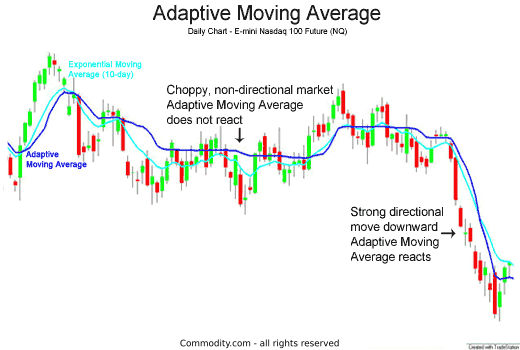
The chart below of the E-mini Nasdaq 100 Futures contract shows the difference between an Exponential Moving Average that weighs current prices more heavily than past prices and the Adaptive Moving Average that changes sensitivity based on price volatility:
How to Interpret Adaptive Moving Averages
The advantage of the Adaptive Moving Average is shown in the above chart in the center where price became directionless and choppy.
During that period, the Adaptive Moving Average maintained a straight-line appearance; whereas the Exponential Moving Average moved with the choppiness of prices.
However, when price trended, like on the far right of the chart above, the Adaptive Moving Average kept up with the Exponential Moving Average.
Where Can I Trade?
FAQ
Below we answer some common questions about Adaptive Moving Average indicators.
How are Adaptive Moving Averages different from simple moving averages?
Adaptive Moving Averages avoid some of the drawbacks inherent in simple moving averages. Adaptive Moving Averages filter out anomalous price jumps to prevent identification of false trends, which simple moving averages can’t. Adaptive Moving Averages also result in less time lag in predicting pricing trends than simple moving averages.
Further Reading on Trend Indicators
These trend tools complement Adaptive Moving Average: Andrew’s Pitchfork, Gann Fans, and Typical Price Moving Average.
Technical analysis is most widely used in CFD and forex trading. If you’re ready to apply these techniques, browse our vetted CFD brokers or forex brokers.



Update history
This page was revised 8 times between August 2020 and April 2026.
Added cross-linking to CFD and forex broker resources in Further Reading section with embedded broker comparison widget.
Replaced generic further reading list with curated trend indicator tools, removed broker recommendations section and table.
Simplified heading by removing "Regulated Brokers" and "Commodities" specificity, and expanded introductory sentence to clarify focus on charting tools and software availability.
Simplified heading and clarified that broker reviews focus on their charting tools and software offerings.
Added introductory overview, table of contents, FAQ section with moving average comparison, regulated brokers table, and Further Reading links; restructured content with proper heading hierarchy and removed outdated "How to Start Trading" section.
Added content alert call-to-action element before the Further Reading section.
Added explanatory paragraphs on Adaptive Moving Average advantages with chart analysis, reorganized content with new "How to Start Trading" section, and corrected grammar.
Removed legal disclaimer and risk disclosure statements from conclusion.
The Commodity Briefing
The stories behind the prices. Surprising, useful, occasionally weird - in your inbox every weekday.
- Price moves
- Supply shocks
- Macro drivers
Before you go
Get The Commodity Briefing - free, 2 minutes.