The Parabolic SAR tracks price trend direction and potential reversals, helping commodity traders spot entries, exits, and trailing stop levels.
In this guide to understanding the Parabolic Stop and Reverse (SAR) indicator, we’ll show you what this chart looks like and explain how it is typically used.
What Is the Parabolic Stop and Reverse (SAR) Indicator?
The Parabolic Stop and Reverse (SAR) indicator combines price and time components in an attempt to generate potential buy and sell signals. The Parabolic SAR advertises itself as an effective tool to determine where to place stop-loss orders.
What Does the Parabolic SAR Look Like?
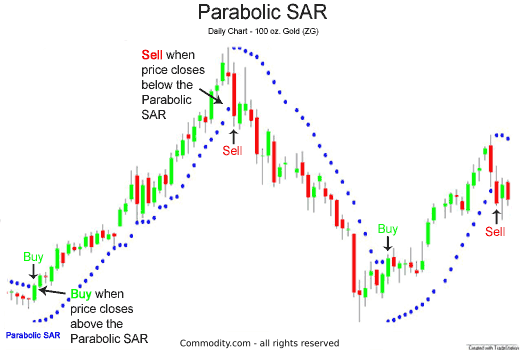
Chart 1 below for the 100-ounce gold futures contract is a good illustration showing possible buy and sell signals generated by the Parabolic Stop and Reverse (SAR) technical indicator:
How to Interpret the Parabolic SAR
The Parabolic SAR indicator created by Welles Wilder and chronicled in his classic New Concepts in Technical Trading Systems attempts to give easy-to-interpret buy and sell signals as well as attempts to create an easy to follow methodology for entering stop-loss orders.
Parabolic SAR Potential Buy Signal
In the situation depicted in Chart 1 above, a trader might buy when the price closes above the upper Parabolic SAR.
When the Parabolic SAR changes from being above price to below price, the trader might stop, buy to cover their existing short-sell, and reverse direction by buying to go long.
Parabolic SAR Potential Sell Signal
Looking at Chart 1 above again, a sell signal is potentially generated when the price closes below the lower Parabolic SAR.
At the time that the Parabolic SAR changes from being below price to being above price, the trader might stop, sell to exit their existing long trade, and reverse direction by selling to go short.
Parabolic SAR Stop-Loss Placement
The Parabolic SAR can also be used as a tool in determining where to place stop-loss orders to protect profits or minimize losses.
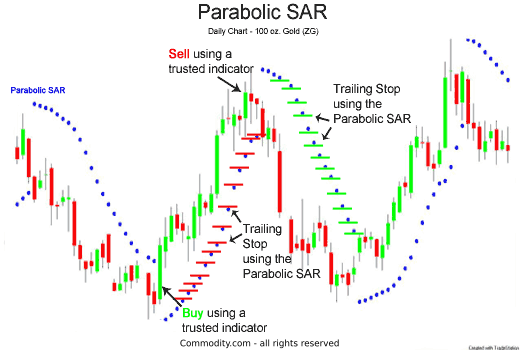
Chart 2 below illustrates stop-loss placement using the Parabolic SAR indicator for Gold:
The Parabolic SAR might be useful to a trader because:
- It acts as a trailing stop.
- It acts as a time stop.
Let’s look at each of these scenarios in more detail.
Parabolic SAR as a Trailing Stop
Rather than putting in one stop-loss below a long position or above a short position, using the Parabolic SAR as a trader’s guide, the stop-loss could be gradually raised for a long position or lowered in a short position, effectively locking in any profits.
Parabolic SAR as a Time Stop
Time stops are used by traders because they enter buy or sell orders expecting a certain move to occur. If the expected move never happens and the reason the trader initiated the trade is no longer relevant, the trader would probably exit their trade.
Similarly, the Parabolic SAR incorporates time into its calculation, making sure a stock, future, or currency trade is working for the trader.
If the trade is not moving in the desired direction, the Parabolic SAR will suggest an exit point.
Where Can I Trade?
Interested in trading commodities, forex, and derivatives? See our reviews of these regulated brokers available in .
Further Reading on Trend Indicators
These trend tools complement Parabolic SAR: Andrew’s Pitchfork, Gann Fans, and Triangular Moving Average.
Technical analysis is most widely used in CFD and forex trading. If you’re ready to apply these techniques, browse our vetted CFD brokers or forex brokers.



Update history
This page was revised 5 times between August 2020 and April 2026.
Added broker recommendation links and CFD/forex trading context to Further Reading section.
Removed table of contents and broker comparison table, restructured Further Reading section to focus on trend indicator tools complementary to Parabolic SAR.
Simplified section heading and expanded introductory text to clarify scope of broker reviews beyond commodities.
Restructured content by adding table of contents, breaking stop-loss section into two subsections with improved explanations, and renaming broker section for clarity.
Reorganized page structure by moving introductory chart reference and splitting sell signal/stop loss content into separate sections, while fixing one spelling error ("determing" to "determining").
The Commodity Briefing
The stories behind the prices. Surprising, useful, occasionally weird - in your inbox every weekday.
- Price moves
- Supply shocks
- Macro drivers
Before you go
Get The Commodity Briefing - free, 2 minutes.