Andrew’s Pitchfork plots three key price points to map likely support, resistance, and trend channels, helping commodity traders spot potential reversals and breakout targets.
In this guide to understanding Andrew’s Pitchfork in technical analysis, we’ll show you what this chart looks like, how to create it step-by-step, and how to interpret it.
Andrew’s Pitchfork, also known as median line studies utilizes the concepts of support and resistance, as well as retracements.
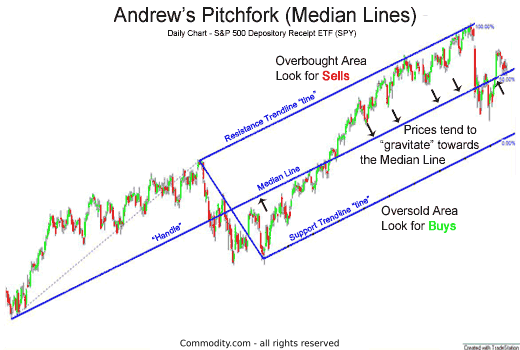
As is visually depicted above, Andrew’s Pitchfork consists of:
- Handle
- Resistance Trendline “tine”
- Median Line
- Support Trendline “tine”
How to Create a Pitchfork
- Find a significant pivot or retracement (in the chart above, the lower-left corner)
- Find the next significant pivot or retracement (the dotted blue line connects the first pivot to this second pivot)
- Find the next retracement (in the chart above, the solid blue line starting from the left and going down to the right)
Charting software finishes the pitchfork by creating the upper resistance tine, the lower support tine, and the median line.
Interpreting Andrew’s Pitchfork
The same rules for support and resistance apply to Andrew’s Pitchfork. Traders might consider buying at support and look to sell at resistance.
Read more about support and resistance.
Also, prices are thought to gravitate towards the median line as depicted in the chart above of the S&P 500 exchange-traded fund (ETF).
The chart above shows the long-term view (1 year and 6 months) of the stock market. However, Andrew’s Pitchfork can be used for shorter time frames.
Regulated Brokers: Where Can I Trade Commodities?
Further Reading on Trend Indicators
These trend tools complement Andrew’s Pitchfork: Bollinger Bands, Keltner Channel, and Typical Price Moving Average.
Technical analysis is most widely used in CFD and forex trading. If you’re ready to apply these techniques, browse our vetted CFD brokers or forex brokers.



Update history
This page was revised 4 times between August 2020 and April 2026.
Added cross-promotional links to CFD and forex broker listings in Further Reading section.
Removed broker comparison table and outdated technical analysis references, then consolidated remaining trend indicator links under a renamed section.
Restructured page layout by renaming section heading, relocating broker reviews and further reading content, adding introductory guide summary, and correcting grammar and terminology throughout.
Added explanatory note clarifying the technical term "tine" and restructured content layout with new section headings.
The Commodity Briefing
The stories behind the prices. Surprising, useful, occasionally weird - in your inbox every weekday.
- Price moves
- Supply shocks
- Macro drivers
Before you go
Get The Commodity Briefing - free, 2 minutes.