
The counter above extrapolates from the annual rate of interest accrual. It is not a live government data feed.
Below, we take a closer look at how Luxembourg’s national debt is calculated, who manages it, and what the country’s credit ratings are.
The National Debt of Luxembourg
The national debt of Luxembourg is counted as the debts accumulated by all layers of the country’s government. It is also known as “general government debt”.
The national debt-to-GDP ratio for Luxembourg as recorded by three top international economic bodies is:
- IMF – 26.9% (2020)
- Eurostat – 21.1% (2019)
- OECD – 30% (2020)
No private-sector debts are included in the national debt figure and there are some public sector debt factors that also aren’t included.
Economists are interested in a country’s ability to repay its debts and so national debt figures are usually expressed as a percentage of the country’s income, or gross domestic product (GDP). This is called the debt-to-GDP ratio and is expressed as a percentage.
International economic bodies use different methods to calculate national debt.
The IMF and the OECD have different rules when calculating a country’s debt.
The IMF doesn’t include those obligations to EU institutions, such as the European Financial Stability Fund. The OECD includes all those EU obligations plus all the guarantees that a government has given for loans to other institutions within its borders.
So, the IMF counts fewer factors than Eurostat does and the OECD includes more.
Both the IMF and the OECD count government securities at their current market value, whereas Eurostat and the government of Luxembourg count those bonds at face value.
These differences in counting rules mean that generally, the IMF comes up with the lowest figures for debt and the OECD figure is usually the highest of all.
Is Luxembourg’s National Debt Growing?
Despite the fact that Luxembourg has enough assets that it could cash in to cover government costs, the country has run a national debt for many years.
For the early years of this century, the country ran a national debt that was equal to about 7.5% of its GDP.
The global financial crisis of 2008 had a big impact on the national debt of Luxembourg — the debt level doubled in 2008 and then continued to rise up in stages to a peak debt to GDP ratio of 23.7% in 2013. After that, the national debt reduced as a percentage of GDP up until 2017 when it rose back up to 2013 levels.
The government of Luxembourg has consistently run annual budget surpluses since 2013. This helped to bring down the national debt up to 2017.
The country’s national debt rose in 2017 even though the government ran a surplus in that year, which means that it had money to spare and didn’t need to borrow.
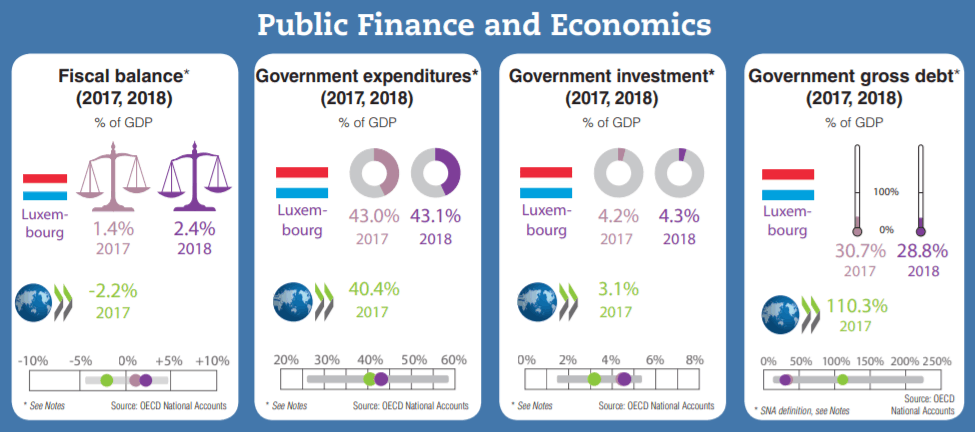
One reason that a country’s debt-to-GDP ratio could rise without the government borrowing any more money is if its GDP falls. However, the country’s GDP rose in 2017.
These factors show that the national debt of Luxembourg rose in 2017 not because the government needed to borrow money, but because one of the other elements in the Eurostat calculations of national debt rose — obligations to EU institutions.
A debt-to-GDP ratio of around 30% in 2020 is largely due to the COVID-19 crisis which can potentially push Luxembourg into a recession.
What Is Luxembourg’s Credit Rating?
The credit ratings calculated by the world’s top four agencies for Luxembourg are shown in the table below.
| Agency | Rating | Outlook |
|---|---|---|
| Moody's | AAA | Stable |
| S&P | AAA | Stable |
| Fitch | AAA | Stable |
| DBRS | AAA | Stable |
Data last reviewed: Warning: data published 5 years ago. Verify before relying on it.
The “triple-A” rating is the best rating possible.
Who Manages Luxembourg’s National Debt?
The parliament of the Grand Duchy of Luxembourg has ultimate control over the country’s debt. The administration sets policy and the ministry of finance is responsible for setting the annual budget.
Debt arises from government spending and so it is the decision of the finance ministry, with the approval of the parliament, that creates the demand for government debt.
The Ministry of Finance gives the task of managing the national debt to the state treasury.
How Does Luxembourg’s Government Raise Loans?
The state treasury raises funds through bank loans and the issuance of bonds. The distribution of the national debt between these two channels is:
- Bonds = 90.2%
- Loans = 9.8%
All loans are taken out from the Banque et Caisse d’Épargne de l’État, a commercial bank, which is entirely owned by the Grand Duchy.
Bonds are known as “Emprunts obligataires”. These are issued directly to a small circle of banks that are on a pre-approved list, known as the “primary dealers”.
When the government conducts an auction of bonds, the dealers submit tenders for a portion of that issuance. This system is called the primary market.
Primary dealers are allowed to sell government securities on the Luxembourg Bourse, where anyone can buy them. This is the secondary market for Luxembourger government bonds.
All Luxembourg government securities are fixed-rate bonds that are denominated in Euros. There are currently bonds with maturities from 5 to 15 years in circulation on the secondary market.
Fun Facts About Luxembourg’s National Debt
Sources and Further Reading
- International Monetary Fund
- Learn more about the state of world government debt from our other country debt clock pages.
- See our global economic indicator guide to more than 45 countries.
The Commodity Briefing
The stories behind the prices. Surprising, useful, occasionally weird - in your inbox every weekday.
- Price moves
- Supply shocks
- Macro drivers
Before you go
Get The Commodity Briefing - free, 2 minutes.
What is national debt?
National debt is the total amount a government owes to lenders - including domestic bondholders, foreign governments, central banks, and the public. It accumulates when annual spending exceeds tax revenue (a deficit). The debt-to-GDP ratio is the standard international measure: it shows what a country owes relative to the size of its economy. Most economists consider ratios below 60% sustainable; above 90%, research by the IMF suggests growth effects become measurable. See our full methodology.