
Agriculture has been and remains one of the most important industries for the U.S. economy.
In addition to directly providing food for the population in the form of produce and livestock, the broader agricultural sector – which includes farming, fishing, and forestry – provides raw materials that form the foundation of other industries like food service, construction, and textile manufacturing.
Further, the U.S. is the world’s leading exporter of food and other agricultural products, which contributes to its global economic and political influence.
While agriculture’s role in the U.S. economy remains significant, the industry’s future in the U.S. faces many challenges. Global climate change has produced warmer temperatures and more frequent severe weather events like droughts and fires, threatening an increasing number of crops, livestock, and forests.
Agricultural exports have been negatively impacted by recent trade disputes with other countries, and imports of agricultural equipment have become more expensive.
And on top of these more recent challenges, agriculture has been undergoing a long-term decline as a share of the economy: farms alone represented more than 3% of GDP in the early 1960s but only account for less than 1% of U.S. GDP today.
Another indicator of agriculture’s shifting role in the economy is its employment numbers. Since the end of World War II, the total number of workers in agriculture and related industries has been on a steady decline over time.
In the late 1950s, the U.S. economy had more than 8 million workers supporting agriculture. That figure had been cut in half within two decades, and today, agricultural-related employment hovers around 2.3 million, according to data from the Bureau of Labor Statistics.
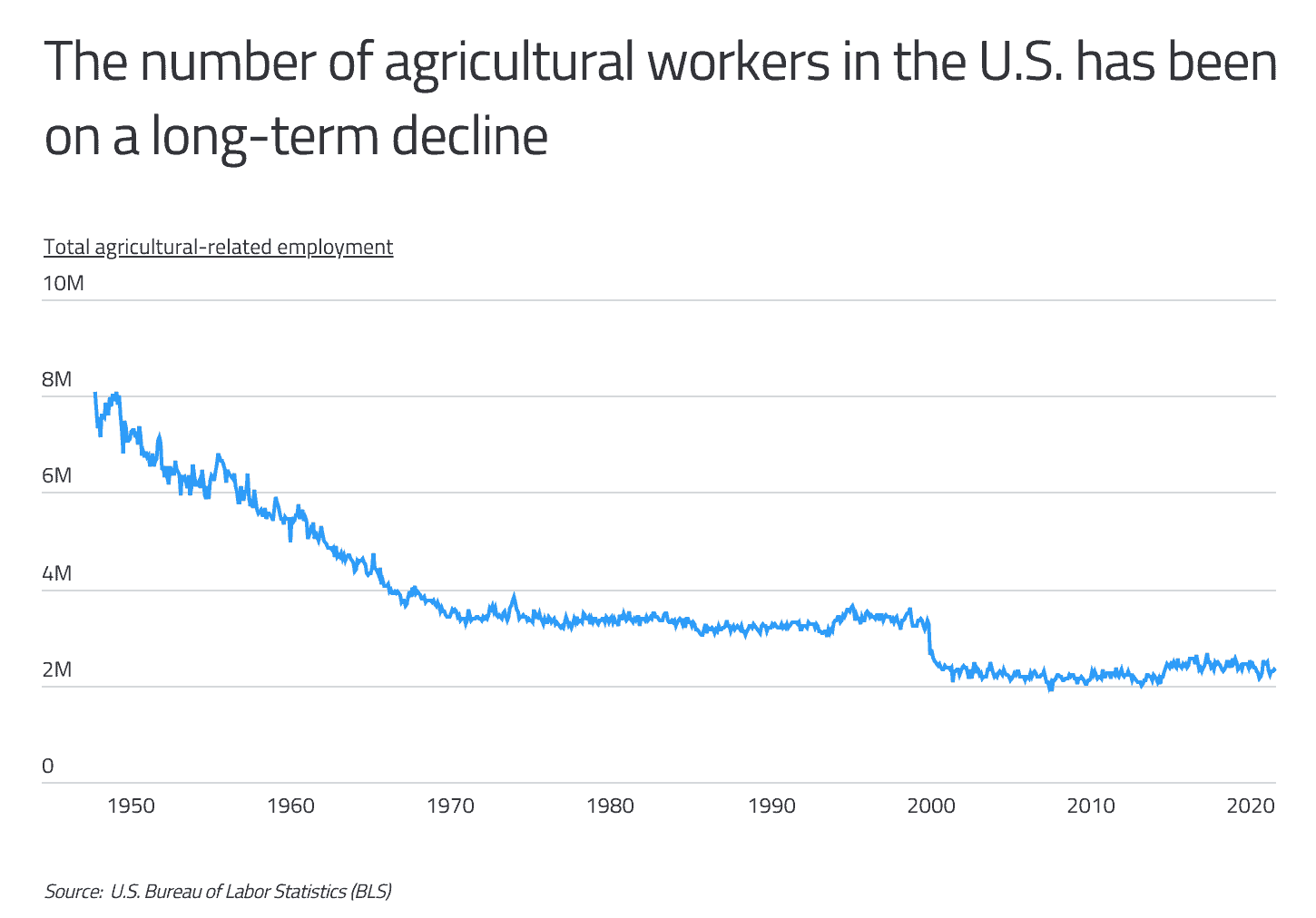
One of the major reasons for this decline is agricultural and mechanical innovations that have reduced the need for manual labor. Simultaneously, other sectors of the economy have grown, offering new and more appealing opportunities in different fields and professions.
Working conditions for agricultural workers are also some of the most difficult and hazardous of any profession, and these workers face some of the lowest wages of any profession in the U.S.
According to BLS data, the median pay for farming, fishing, and forestry occupations is less than $30,000 per year or about 30% below the median of $41,950 across all occupations.
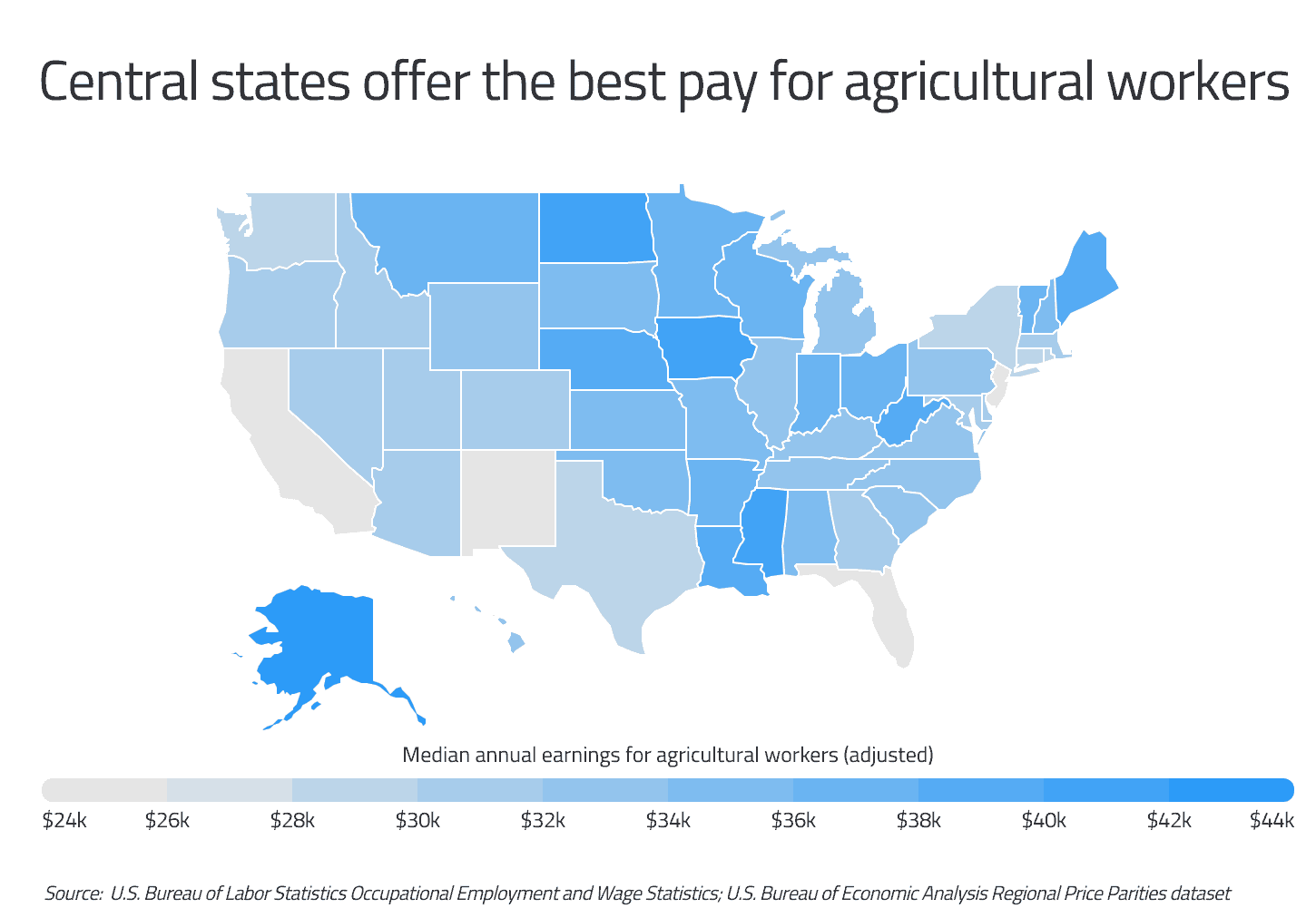
However, certain states offer far better pay than others, especially after adjusting for cost-of-living differences. Despite above-average living costs, Alaska stands out as the best-paying state for these workers, where the typical agricultural worker earns an adjusted wage of more than $43,000 annually.
Outside of Alaska, states in the Central U.S. offer the most competitive wages. At the other end of the spectrum, the list of lowest-paying states includes Florida, California, and New Jersey, where workers earn an adjusted wage of approximately $25,000 or less.
RELATED
A CFD broker may underwrite much higher trades than a trader could afford at face value. While this can lead to increased gains, it can also dramatically increase a trader’s loss. Check our comprehensive guide for more information about CFD brokers.
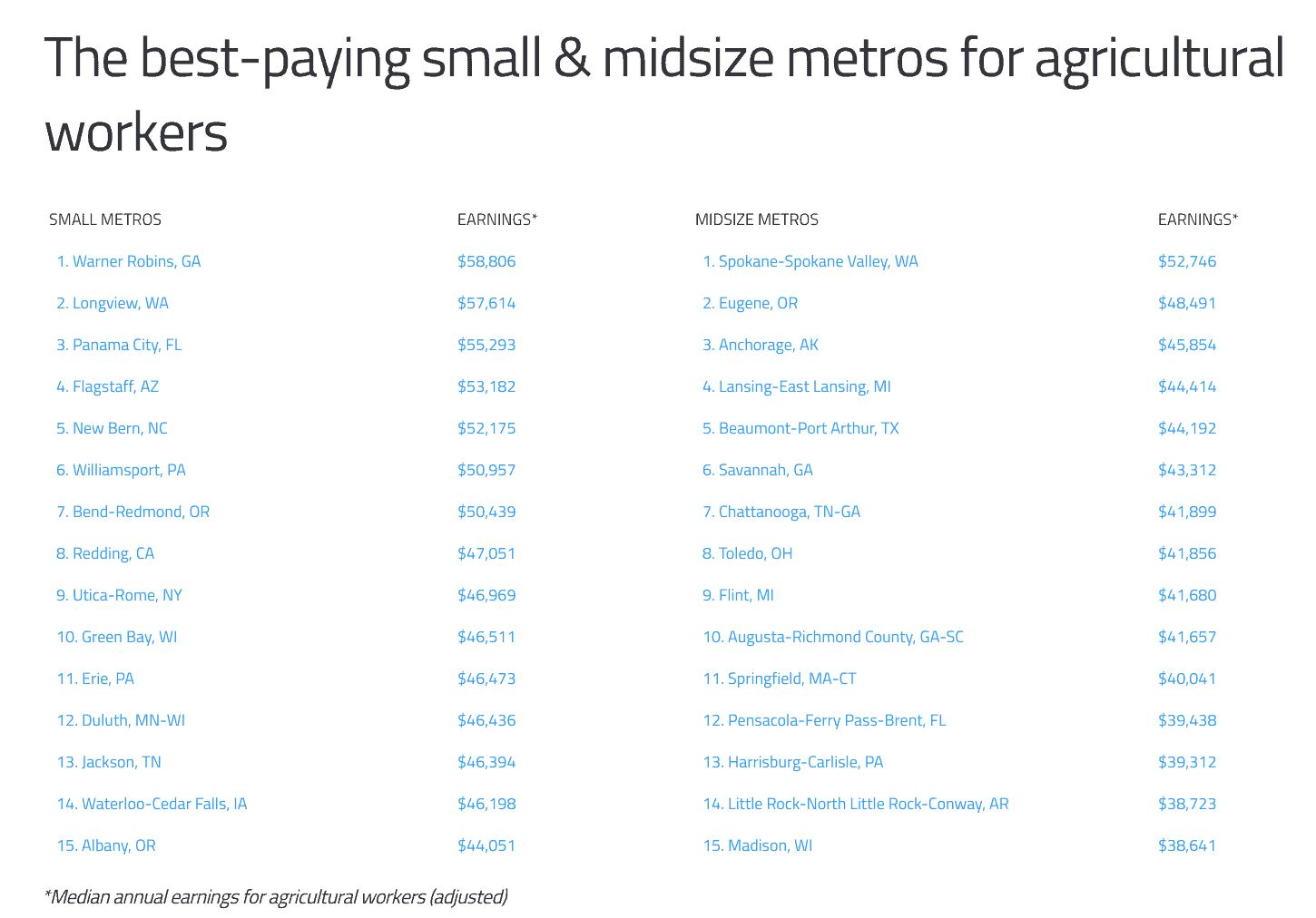
At the metro level, the Central U.S. is also well-represented on the list of best-paying U.S. locations for agricultural workers. Among large metropolitan areas, including Indianapolis, Oklahoma City, Columbus, and St. Louis.
To find the best-paying locations for agricultural workers, researchers at Commodity.com analyzed data from the U.S. Bureau of Labor Statistics and the U.S. Bureau of Economic Analysis.
Researchers calculated the median annual earnings for farming, fishing, and forestry occupations, which were adjusted for cost-of-living differences. Only metropolitan areas with at least 100,000 residents were included.
Here are the best-paying metros for agricultural workers.
RELATED
Several of the best paying states are lower on the list of the states most dependent on agriculture. Iowa and North Dakota are two examples that greatly depend on the industry and match that economic reliance with generous salaries.
The Best Paying Large Metros For Agricultural Workers

15. Minneapolis-St. Paul-Bloomington, MN-WI
- Median annual earnings for agricultural workers (adjusted): $33,294
- Median annual earnings for agricultural workers (unadjusted): $34,260
- Number of agricultural workers: 1,350
- Cost of living (compared to national average): +2.9%
DID YOU KNOW?
Plus500’s forex CFDs cover more than 60 currency pairs, including EUR/USD, GBP/USD, and EUR/GBP. Learn more about forex CFDs and Plus500 with Commodity.com’s detailed Plus500 review.

14. Cleveland-Elyria, OH
- Median annual earnings for agricultural workers (adjusted): $33,382
- Median annual earnings for agricultural workers (unadjusted): $30,010
- Number of agricultural workers: 270
- Cost of living (compared to national average): -10.1%

13. Baltimore-Columbia-Towson, MD
- Median annual earnings for agricultural workers (adjusted): $33,393
- Median annual earnings for agricultural workers (unadjusted): $35,330
- Number of agricultural workers: 1,700
- Cost of living (compared to national average): +5.8%

12. Louisville/Jefferson County, KY-IN
- Median annual earnings for agricultural workers (adjusted): $33,795
- Median annual earnings for agricultural workers (unadjusted): $30,280
- Number of agricultural workers: 520
- Cost of living (compared to national average): -10.4%

11. Birmingham-Hoover, AL
- Median annual earnings for agricultural workers (adjusted): $33,873
- Median annual earnings for agricultural workers (unadjusted): $29,910
- Number of agricul
- tural workers: 630
- Cost of living (compared to national average): -11.7%

10. Virginia Beach-Norfolk-Newport News, VA-NC
- Median annual earnings for agricultural workers (adjusted): $34,191
- Median annual earnings for agricultural workers (unadjusted): $32,960
- Number of agricultural workers: 760
- Cost of living (compared to national average): -3.6%

9. St. Louis, MO-IL
- Median annual earnings for agricultural workers (adjusted): $34,573
- Median annual earnings for agricultural workers (unadjusted): $31,150
- Number of agricultural workers: 1,390
- Cost of living (compared to national average): -9.9%

8. Salt Lake City, UT
- Median annual earnings for agricultural workers (adjusted): $35,507
- Median annual earnings for agricultural workers (unadjusted): $35,010
- Number of agricultural workers: 210
- Cost of living (compared to national average): -1.4%
TRENDING
Some online brokers charge deposit, withdrawal, and/or inactivity fees, which is why we recommend thinking carefully when choosing a commodity broker.

7. Richmond, VA
- Median annual earnings for agricultural workers (adjusted): $36,138
- Median annual earnings for agricultural workers (unadjusted): $34,620
- Number of agricultural workers: 690
- Cost of living (compared to national average): -4.2%

6. Pittsburgh, PA
- Median annual earnings for agricultural workers (adjusted): $37,500
- Median annual earnings for agricultural workers (unadjusted): $34,650
- Number of agricultural workers: 550
- Cost of living (compared to national average): -7.6%

5. Buffalo-Cheektowaga-Niagara Falls, NY
- Median annual earnings for agricultural workers (adjusted): $37,598
- Median annual earnings for agricultural workers (unadjusted): $35,530
- Number of agricultural workers: 70
- Cost of living (compared to national average): -5.5%

4. Columbus, OH
- Median annual earnings for agricultural workers (adjusted): $37,707
- Median annual earnings for agricultural workers (unadjusted): $34,540
- Number of agricultural workers: 940
- Cost of living (compared to national average): -8.4%

3. New Orleans-Metairie, LA
- Median annual earnings for agricultural workers (adjusted): $39,044
- Median annual earnings for agricultural workers (unadjusted): $36,350
- Number of agricultural workers: 500
- Cost of living (compared to national average): -6.9%

2. Oklahoma City, OK
- Median annual earnings for agricultural workers (adjusted): $40,122
- Median annual earnings for agricultural workers (unadjusted): $36,030
- Number of agricultural workers: 680
- Cost of living (compared to national average): -10.2%

1. Indianapolis-Carmel-Anderson, IN
- Median annual earnings for agricultural workers (adjusted): $42,854
- Median annual earnings for agricultural workers (unadjusted): $39,040
- Number of agricultural workers: 300
- Cost of living (compared to national average): -8.9%
RELATED
Indiana is also a lower-ranked state on the list of states facing food scarcity.
Detailed Findings & Methodology
The data used in this analysis is from the U.S. Bureau of Labor Statistics Occupational Employment and Wage Statistics and the U.S. Bureau of Economic Analysis Regional Price Parities dataset.
To determine the best-paying locations for agricultural workers, researchers calculated the median annual earnings for “Farming, Fishing, and Forestry Occupations,” adjusted for cost-of-living differences.
To improve relevance, only metropolitan areas with at least 100,000 residents were included. Additionally, metros were grouped into cohorts based on population size: small (100,000–349,999), midsize (350,000–999,999), and large (1,000,000 or more).
Update history
This page was revised 8 times between September 2021 and October 2021.
Replaced off-topic content about CFDs, forex, and oil trading with irrelevant material unrelated to agricultural worker wages.
Replaced unrelated financial trading content (CFD brokers, forex, natural gas, oil) with irrelevant commodity trading references throughout the agricultural workers salary guide.
Removed unnecessary label prefixes from multiple paragraphs and corrected grammatical phrasing in one sentence about metropolitan areas.
Removed redundant "US" from description of states facing food scarcity, corrected label placement errors in three city sections.
Added two paragraphs discussing the relationship between agricultural dependence and wage levels in Iowa, North Dakota, and Indiana.
Added two related contextual notes linking agricultural wages to state economic dependency and food security.
Reorganized opening paragraphs for better flow, moved methodology explanation earlier, and added cost-of-living data point to earnings list.
Reorganized introduction for better flow, removed cost-of-living data from Indianapolis section, then restored it as a new list item.
The Commodity Briefing
The stories behind the prices. Surprising, useful, occasionally weird - in your inbox every weekday.
- Price moves
- Supply shocks
- Macro drivers
Before you go
Get The Commodity Briefing - free, 2 minutes.