Williams %R measures whether a commodity is overbought or oversold, helping traders spot potential buy and sell signals before price reversals.
Williams %R is an overbought and oversold technical indicator that may offer potential buy and sell signals. Williams %R is very similar to the Stochastic Fast indicator (see: Stochastics) as the chart below will illustrate:

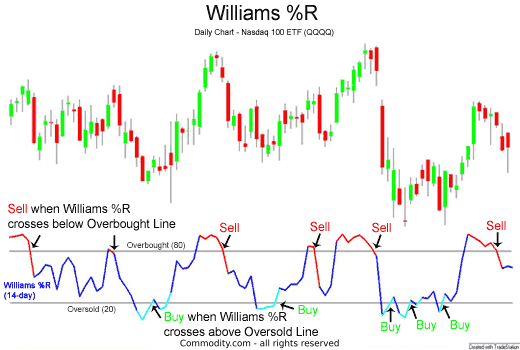
Like Stochastics, the Williams %R indicator attempts to give buy and sell signals, as is demonstrated in the chart below of the Nasdaq 100 exchange-traded fund QQQQ:
Williams %R Potential Buy Signal
When the Williams %R indicator is below the oversold line (20) and it rises to cross over the 20 line, then a trader might buy.
Williams %R Potential Sell Signal
A trader might sell when the Williams %R indicator is above the overbought line (80) and then falls below the 80 line.
Furthermore, the Williams %R indicator may help identify strong trends; this is discussed on the next page.
Williams %R and Trends
Since the Williams %R indicator is similar to Stochastics, it might be useful during sideways, non-trending markets. However, during trends, the Williams %R probably does not fare as well.
Nevertheless, the Williams %R indicator can give tell-tale signs of strong trends. The following chart of the Nasdaq 100 ETF (QQQQ) illustrates Williams %R’s ability to detect such trends:

As the chart of the QQQQ illustrates, when the Williams %R indicator stays in the oversold area (below 20) and any bullish rally barely registers with the Williams %R (i.e. fails to go above 80), then the downtrend appears to be strong and a trader might avoid any potential buy signals.
Similarly, when the Williams %R indicator stays in the overbought area (above 80) and any attempt at a downturn fails to send the indicator into oversold territory (i.e. fails to go below 20), then the uptrend appears to be strong and a trader might avoid going short.
The Stochastic indicator (see: Stochastics) would be a logical next step for investigation.
How to Get Started Trading
Further Reading on Momentum Indicators
These momentum tools complement Williams %R: ADX Indicator, Directional Movement Index (DMI), and Relative Strength Index (RSI).
Technical analysis is most widely used in CFD and forex trading. If you’re ready to apply these techniques, browse our vetted CFD brokers or forex brokers.



Update history
This page was revised 4 times between August 2020 and April 2026.
Added broker recommendation section with links to vetted CFD and forex trading platforms in Further Reading.
Added new section on complementary momentum indicators (ADX, DMI, RSI) to Further Reading, reorganized section headings.
Reorganized Williams %R signals into distinct sections and streamlined trend analysis by removing redundant introductory text.
Removed boilerplate disclaimer text from two sections.
The Commodity Briefing
The stories behind the prices. Surprising, useful, occasionally weird - in your inbox every weekday.
- Price moves
- Supply shocks
- Macro drivers
Before you go
Get The Commodity Briefing - free, 2 minutes.